
Retrofit philosophy
Improve compatible equipment already in service, subject to condition, motor, electrical, controls, ventilation, and access review.
Preparing building intelligence…
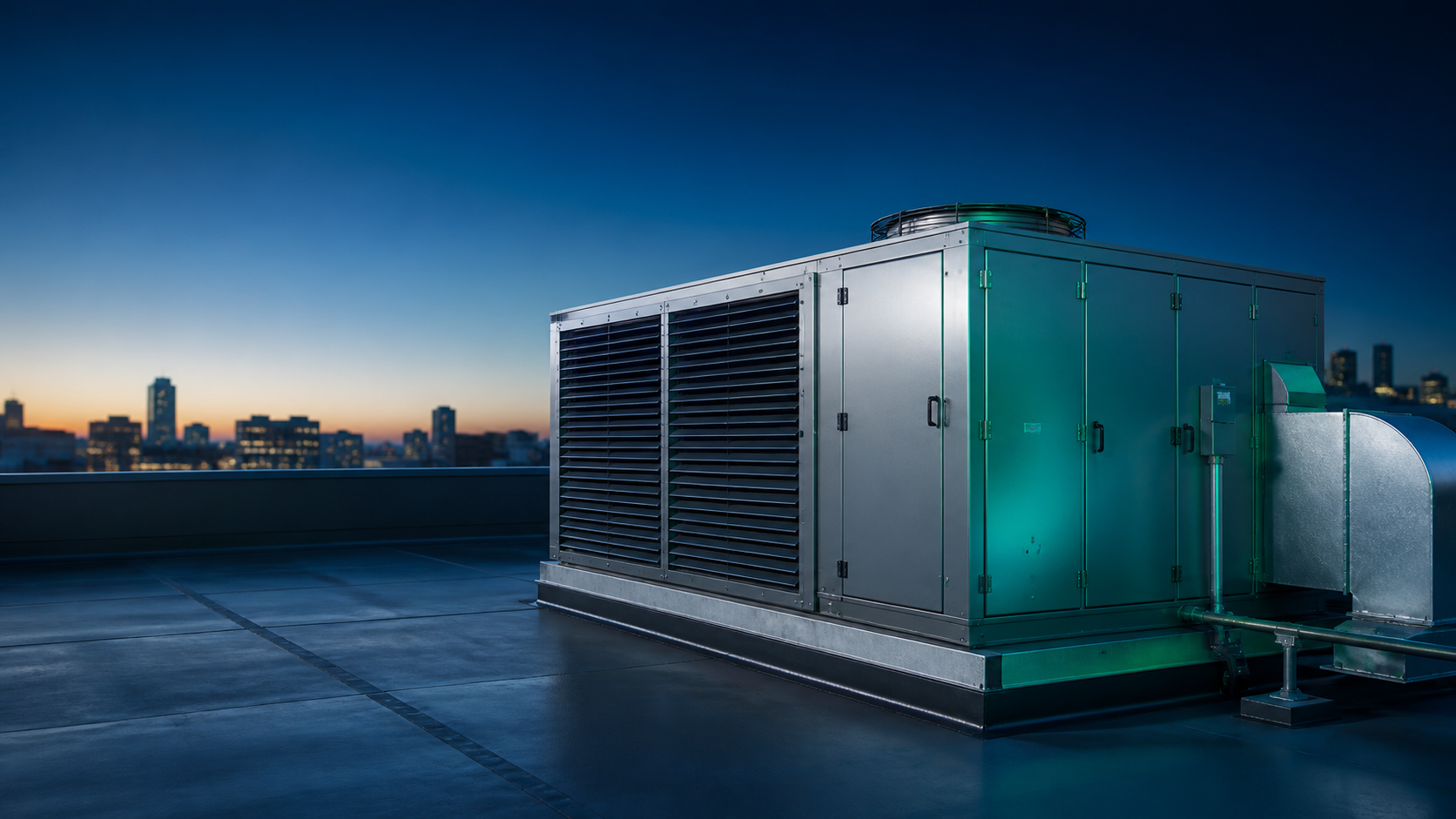
RTU-SC is an engineering-led retrofit platform for qualifying packaged rooftop HVAC units. It coordinates variable fan control, refrigeration safeguards, sensing, analytics, and connected visibility without requiring full equipment replacement.
Conceptual commercial rooftop-unit application. Final RTU-SC configuration is project-specific.
RTU-SC brings adaptive control and operational intelligence to qualifying existing rooftop units. The platform measures operating conditions, applies commissioned logic, and modulates the evaporator fan through a VFD while coordinating with the existing thermostat, BMS, or approved control sequence.
Improve compatible equipment already in service, subject to condition, motor, electrical, controls, ventilation, and access review.
Approved analytics can help identify operating patterns, support review, and organize portfolio information. Final control authority remains engineered and commissioned.
Supported architectures may use BACnet/IP or appropriately routed BACnet MS/TP for BMS, meter, controller, and Gateway integration.
Local and cloud interfaces may provide trends, alarms, schedules, sensor values, energy context, and authorized portfolio views.
RTU-SC does not make every rooftop unit eligible. A facility assessment and engineering review define compatibility, scope, safeguards, and expected performance.
Qualify the unit, controls, fan motor, refrigeration condition, ventilation, and operating profile.
Collect approved sensor signals and apply commissioned control and protection logic.
Command the VFD within engineered minimum and maximum fan-speed limits.
A retrofit path that can improve qualifying assets before full replacement is justified.
Centralized operating context, schedules, alarms, and trends for supported RTU portfolios.
Better visibility into sensor conditions, fan commands, alarms, and operating history.
A documented framework for screening, baselining, evaluating, and reporting energy performance.
Project-specific cost, savings, ROI, and payback scenarios based on reviewed facility data.
Connect approved controllers, gateways, meters, and BMS points across supported IP networks.
Integrate supported field devices through approved routing and network architecture.
Aggregate authorized multi-unit data and reduce the need for independent external connections.
Use approved analytics to support pattern review, prioritization, and operating insight.
Modulate compatible evaporator-fan motors within commissioned operating limits.
RTU-SC targets avoidable fan energy and associated cooling work in qualifying applications. Each project requires a defined baseline, energy boundary, operating context, and approved evaluation method.
Approved range for qualifying RTU-SC applications; not a guarantee.
Potential benefit from improved operation; no universal life-extension claim is made.
Trend visibility may support maintenance decisions; outcomes depend on facility practice.
Airflow modulation may support moisture removal when equipment and climate conditions allow.
Supported IAQ sensors may add temperature, humidity, CO₂, VOC, and PM2.5 context.
Emissions impact follows the approved energy result and location-specific factor.
Requires confirmed scope, cost, tariff, incentives, and energy assumptions.
Presented only after project investment and annual savings inputs are defined.
All savings, financial, humidity, maintenance, equipment-life, IAQ, and carbon outcomes are project-specific. Estimated values must be labeled as estimates until verified through an approved methodology.
Fan may operate at constant speed when full airflow is unnecessary.
Fan speed is modulated within commissioned limits when conditions permit.
Airflow may not adapt to changing space and refrigeration conditions.
Control logic coordinates airflow with measured operating conditions.
Excess airflow may limit moisture-removal opportunity in some conditions.
Commissioned airflow modulation may support dehumidification.
Operating history may be fragmented across local controls.
Supported trends and alerts create clearer operating context.
Replacement may be considered without a controls-improvement path.
A retrofit path may improve qualifying equipment before replacement.
Limited current and historical information may be available.
Authorized local, cloud, and portfolio views may be configured.
Existing thermostat or BMS typically manages basic calls.
RTU-SC coordinates fan control with approved existing sequences.
Performance comparisons may require manual data assembly.
Measured and calculated data can support structured evaluation.
RTU-SC is installed around qualifying existing equipment. The project plan defines access, temporary shutdowns, electrical work, controls integration, commissioning, and operating continuity.
Review RTU inventory, controls, electrical data, condition, runtime, ventilation, utility data, and site constraints.
Confirm compatible units, sensors, VFD, controller, network, safeguards, and measurement approach.
Install approved controls and field components during coordinated work windows; the RTU is not automatically replaced.
Validate sensors, fan limits, refrigeration safeguards, schedules, alarms, fallback behavior, and integration.
Review representative operating and energy information under the approved methodology.
Provide configured views, documentation, training, responsibilities, and next-step recommendations.
There is no universal installation duration. Timing depends on unit quantity and configuration, access, electrical scope, network approvals, repairs, commissioning, and facility work windows. Plans are designed to minimize downtime while protecting operational requirements.
These records preserve the classifications and limitations in the approved case-study repository.
 Grupo Carso / Sanborns
Customer-reported project information describes a June 2019 pilot followed by authorization for a larger deployment.
Customer-reported pilot energy savings; measurement boundary and independent verification require documentation.
 Cinemex
The original DLV website documents an October 2018 pilot involving 11 RTU-SC controls at Cinemex San Pedro.
Documented pilot result; not published as a savings claim because the affected energy boundary is unresolved.
Project documentation describes an active multi-site deployment with network, programming, sequencing, and training considerations.
Customer-reported scope. No final performance result is published.
It modulates compatible evaporator-fan speed within engineered limits, reducing unnecessary fan energy and potentially associated fan heat and cooling work.
No. RTU-SC is retrofit-oriented and is evaluated for compatible existing rooftop units.
Duration varies with quantity, configuration, access, electrical work, network approvals, repairs, and commissioning. No universal duration is stated.
Not in every configuration. Local, standalone, Gateway, cloud, and BMS architectures are defined during engineering review.
Supported architectures may use BACnet/IP and appropriately routed BACnet MS/TP, subject to points, ownership, network, and client approval.
Authorized remote visibility may be configured within the client’s IT, access, retention, and cybersecurity requirements.
Potentially. The existing thermostat, BMS, control ownership, sequences, electrical design, and fallback behavior must be reviewed.
Maintenance depends on the approved controller, VFD, sensors, electrical components, network, software, and the underlying RTU. Project documentation defines responsibilities.
Yes, when compatible controllers and the approved Gateway, BACnet, network, and cloud architecture support multi-unit supervision.
Request the current approved revision for your project. Placeholder cards do not represent public technical releases.
Executive product overview and application framework.
Available on request after scope and revision review.Request documentProject-specific controller, sensor, VFD, I/O, and power requirements.
Available on request after scope and revision review.Request documentConceptual BACnet/IP, BACnet MS/TP, BMS, Gateway, and remote-access topology.
Available on request after scope and revision review.Request documentShare your RTU inventory, operating profile, controls, utility information, and business objectives. DLV Energy will identify which units and project strategies merit engineering review.
Coordinate airflow with measured refrigeration and space conditions.
Lower avoidable fan heat and cooling work where operating conditions support it.
Reduce unnecessary fan energy and evaluate the affected energy boundary.
Support temperature, humidity, and ventilation objectives within commissioned limits.
Organize authorized trends, alarms, schedules, performance context, and portfolio views.
This is a conceptual sequence. Actual control logic, sensors, integration, and results depend on the approved project configuration.
Estimated energy and emissions context clearly separated from verified performance results.
Apply to qualifying packaged rooftop units after electrical, mechanical, and controls review.
Support refrigeration, temperature, humidity, current, optional IAQ, and optional power data.
Provide authorized local or cloud visibility subject to client IT and security requirements.
Record selected operating values for commissioning, diagnostics, and performance review.
Surface configured operating conditions that warrant facility or engineering attention.
Organize measured and calculated values without presenting estimates as verified results.
Prepare technical, operational, portfolio, and executive views using approved data boundaries.
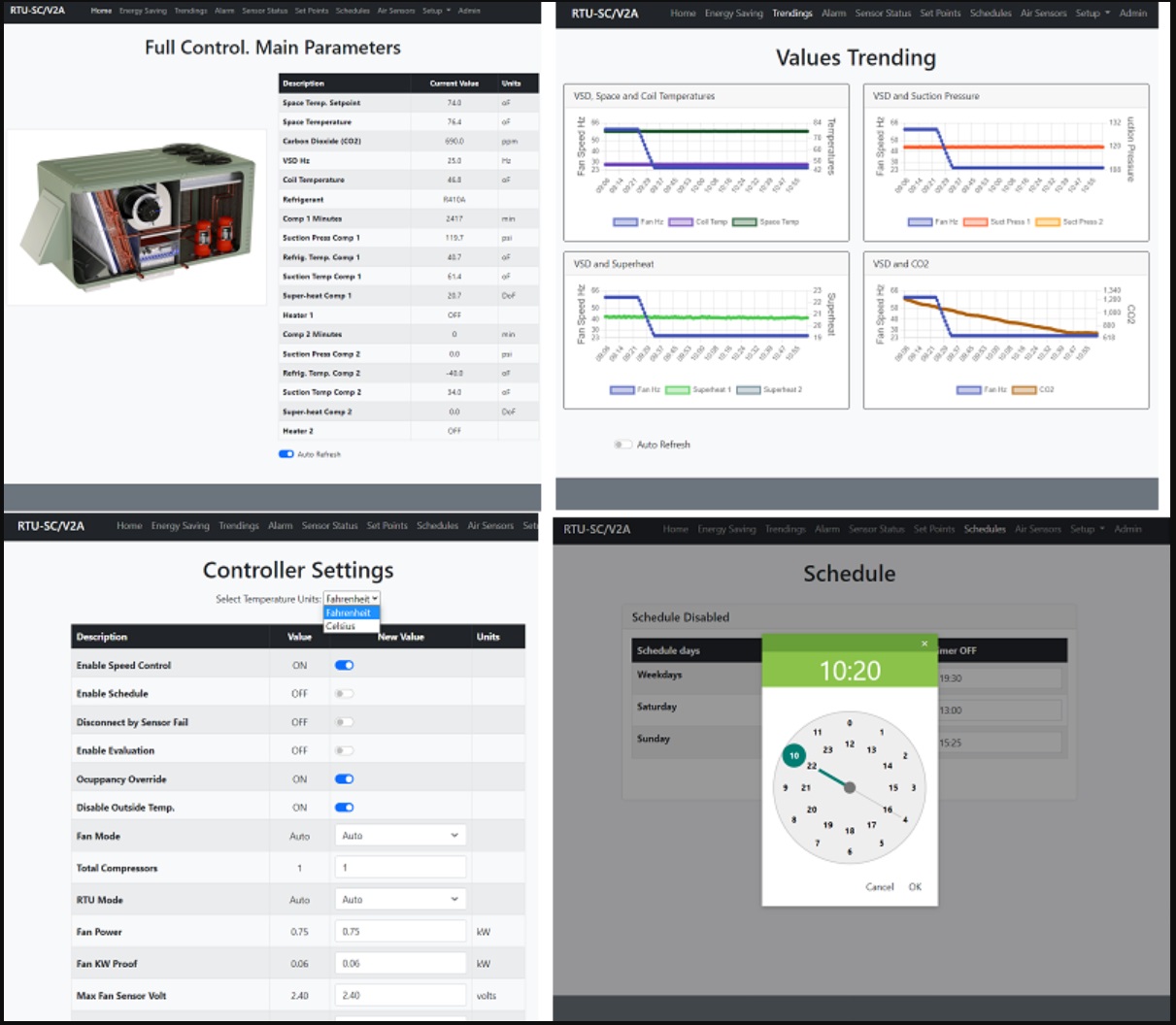
Appropriate airflow reduction may support moisture removal, but results depend on climate, equipment sizing, coil condition, ventilation, runtime, and commissioning.
Site planning, field installation, commissioning, and handover requirements.
Approved RTU-SC project records and evidence classifications.
Available on request after scope and revision review.Request document